Ingredients
Method
- Season the beef fillet generously all over with salt and pepper.
- Heat oil in a pan until it is extremely hot. Sear the fillet on all sides, including the two ends, only briefly and very hard: about 1 minute per side according to the original recipe. (General guidance, not from the original recipe: a cylinder has more than four sides, so work your way around it.)
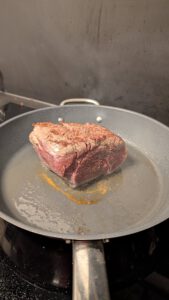
- The fillet should be browned all around but still raw inside. Take it out of the pan right away.
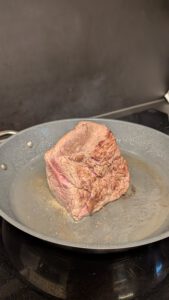
- While it is still hot, brush the fillet all over with a thin layer of the medium hot mustard. Check the label first: the mustard must contain no wheat flour or other gluten-containing ingredients.
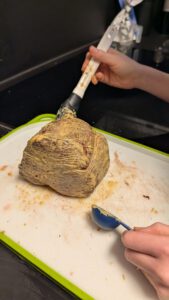
- Now comes the first golden rule: let the fillet cool completely. The original recipe gives no time. (General guidance: it should feel cold to the touch before it goes near the pastry, otherwise the butter in the pastry melts.)
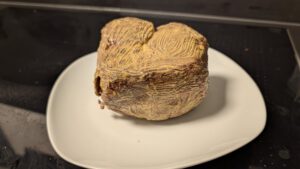
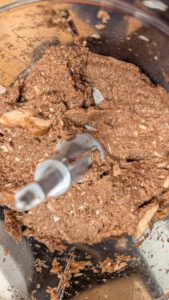
- Make the duxelles. Chop the mushrooms extremely fine, ideally in a food processor, until they look like soil or fine crumbs.
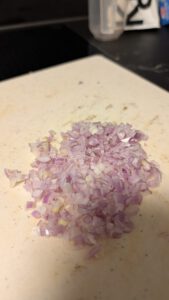
- Finely chop the shallot and the garlic clove.
- Cook the mushroom crumbs with the shallot and garlic in a pan, using no oil or only very little. At first the mixture is wet (see the photo).
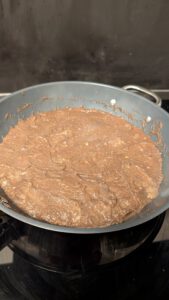
- Add the thyme and keep cooking until the liquid has evaporated. If you like, deglaze with a splash of white wine or sherry (optional, no amount in the original recipe). Second golden rule: cook the mixture until it is almost completely dry. The original recipe adds that if you think it is dry enough, you should cook it 2 minutes longer. Wet mushrooms mean a soggy pastry bottom.
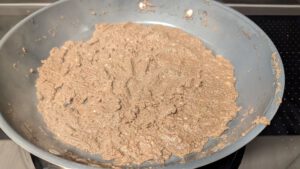
- Let the duxelles cool completely. The original recipe gives no time.
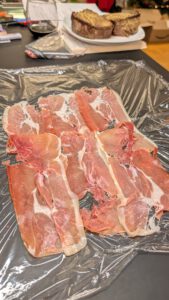
- Spread a large sheet of plastic wrap on the work surface. Lay the prosciutto slices on it, overlapping like roof tiles, to form a rectangle big enough to wrap around the fillet. The prosciutto works as a moisture barrier.
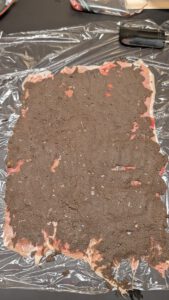
- Spread the cold duxelles evenly over the prosciutto.
- Place the cold fillet in the middle. Using the plastic wrap, roll the prosciutto tightly around the meat. Twist the ends of the wrap like a candy wrapper to pull the roll really tight. (General guidance: a tight roll holds its shape and leaves no air gaps.)
- Chill the roll in the fridge for at least 30 minutes. This firms up the shape.
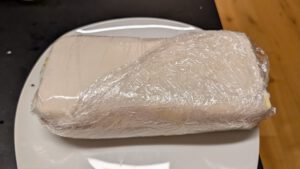
- Roll out the Schär gluten-free puff pastry (follow the package directions for thawing). Take the meat out of the plastic wrap and place it on the pastry. Brush the pastry edges with egg yolk. (If you roll out gluten-free pastry on a surface that has had wheat flour on it, clean the surface and tools first.)
- Fold the pastry around the meat. Cut off excess pastry, because too much overlap on the bottom does not cook through. Press the edges together firmly. Wrap the whole thing tightly in plastic wrap again and chill for another 15 to 30 minutes.
- Preheat the oven to 200 degrees C (390 degrees F) top and bottom heat. The original recipe does not mention a fan oven.
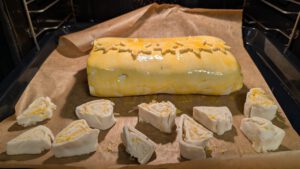
- Unwrap the Wellington and place it on a baking tray. Brush it all over with egg yolk (general guidance: the yolk gives the golden shine). With the back of a knife, gently score a pattern into the pastry, and do not cut through. (The pastry in the photo is also decorated with snowflake cut-outs, which are not part of the original recipe.)
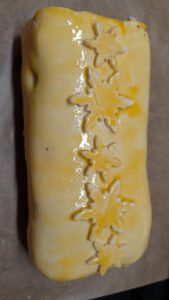
- Ready for the oven. In the photo the tray is lined with baking paper (not mentioned in the original recipe), and offcuts of pastry baked beside the Wellington.
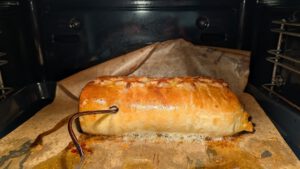
- Bake for about 30 to 35 minutes. The original recipe says a meat thermometer is highly recommended; the photo shows a probe thermometer cable running into the oven.
- About 15 minutes before the Wellington is done, start the carrots. Heat the olive oil or butter in a wide pan over medium heat. Add the carrot sticks and the fresh rosemary sprigs, then a pinch of salt and the water.
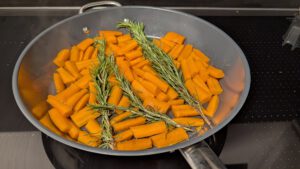
- Cover and cook the carrots over medium heat for about 8 to 10 minutes, until they are nearly tender. Check them with a fork.
- Remove the lid, add the honey or maple syrup and cook for another 2 to 3 minutes, turning the carrots, until the liquid is reduced to a glaze. Remove the rosemary sprigs and keep the carrots warm.
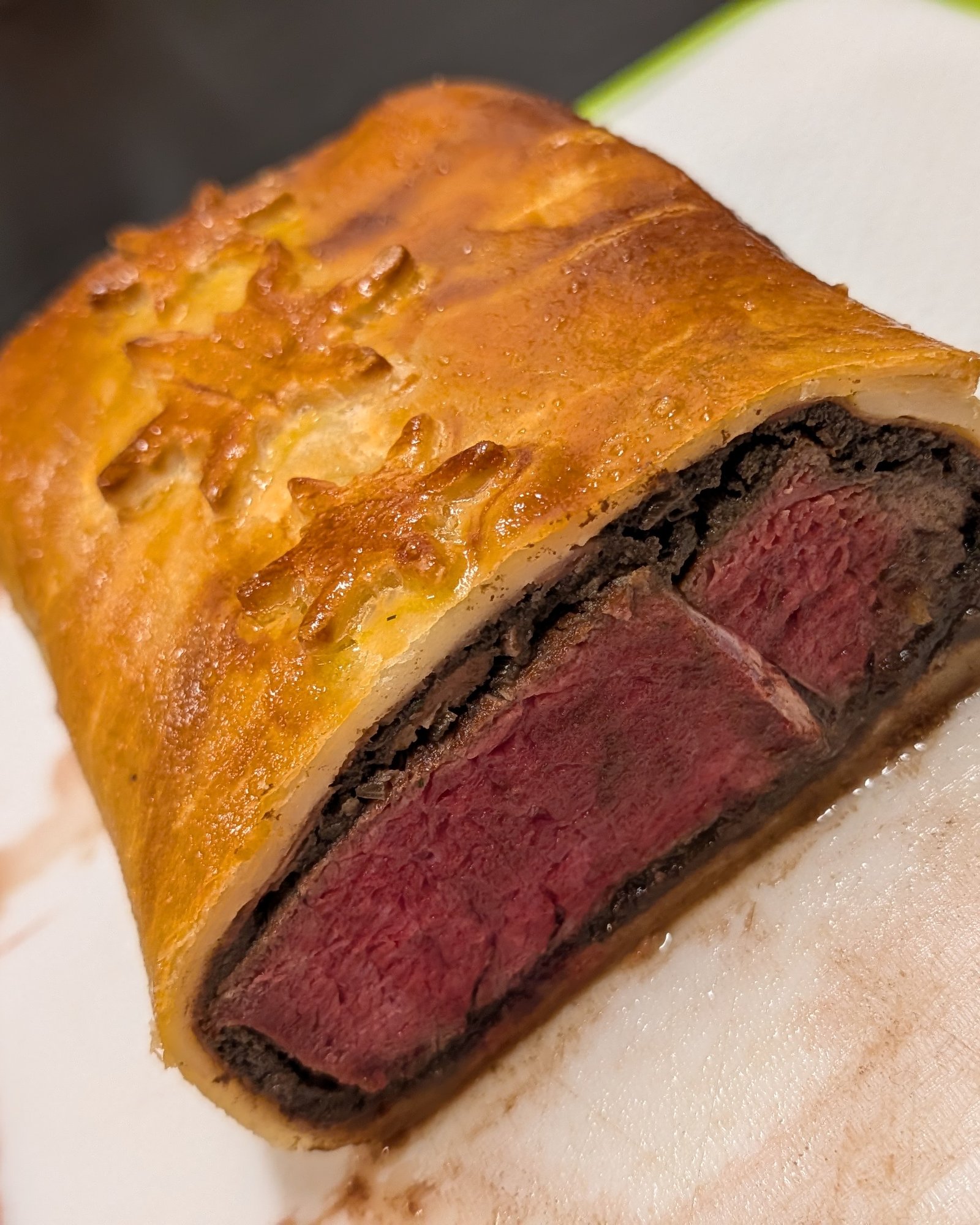
- Take the Wellington out when the core reaches the temperature you like, measured with a thermometer: medium-rare 52 to 57 degrees C (126 to 135 degrees F), medium 60 to 63 degrees C (140 to 145 degrees F). My own preference is the lower end of medium-rare, 52 to 54 degrees C (126 to 129 degrees F). The temperature rises a few degrees while it rests. Safety note: the USDA guideline for whole cuts of beef is 63 degrees C (145 degrees F) with a 3-minute rest, so medium-rare is below that and is not a claim that it is safe. Medium-rare beef is not recommended for pregnant women, small children or people with a weakened immune system; for them cook to the USDA temperature. In the photo the pastry has turned golden.
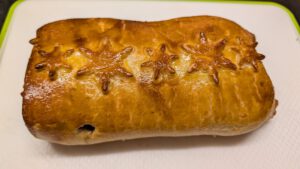
- Third golden rule: do not slice it right away. Let it rest for at least 10 minutes, otherwise the juices run out and the meat dries. Then slice and serve.
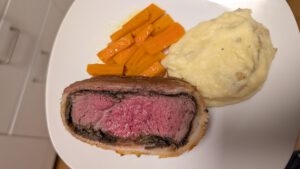
- Serve slices of the Wellington with the Knorr Soße zu Braten (roast gravy mix), the glazed carrots and mashed potatoes (see our recipe for Gluten-Free Mashed Potatoes).
Notes
The three golden rules, from the original recipe. 1. Everything must be cold: never wrap warm meat in puff pastry, because the butter in the pastry melts and the pastry does not rise. 2. Dry mushrooms: if you think they are dry enough, cook them 2 minutes longer, because moisture is the enemy. 3. The rest: never slice right after the oven, rest at least 10 minutes, or the juices run out and the meat dries.
Gluten-free: a classic Beef Wellington uses wheat-based puff pastry. This version uses Schär gluten-free puff pastry; always check the pack. Check the labels of the mustard (English mustard often contains wheat flour), the prosciutto, the thyme, the optional wine or sherry, and the Knorr Soße zu Braten (roast gravy mix). If you roll out gluten-free pastry, use a clean surface and clean tools to avoid cross-contact. No medical claim is made here.
Food safety: choose your doneness by core temperature (see the guide below). My own preference, 52 to 54 degrees C (126 to 129 degrees F) for medium-rare, is below the USDA guideline for whole cuts of beef (63 degrees C / 145 degrees F with a 3-minute rest), so it is not a claim that it is safe. Medium-rare beef is not recommended for pregnant women, small children or people with a weakened immune system; for them cook to the USDA temperature. A thermometer is the only reliable way to know the core temperature.
Doneness guide for beef, core temperature as commonly used by cooks (not an official safety rating). Rare: 49 to 51 degrees C (120 to 124 degrees F). Medium-rare: 52 to 57 degrees C (126 to 135 degrees F). Medium: 60 to 63 degrees C (140 to 145 degrees F). Medium-well: 65 to 68 degrees C (150 to 155 degrees F). Well done: 71 degrees C (160 degrees F) and above. The temperature keeps rising a few degrees while the meat rests, so take it out of the oven slightly below your target. US recommendation: the USDA gives a safe minimum internal temperature of 63 degrees C (145 degrees F), measured with a food thermometer, followed by a 3-minute rest, for whole cuts of beef such as steaks, roasts and tenderloin. Ground beef should reach 71 degrees C (160 degrees F). USDA does not recommend rare or medium-rare beef, particularly for pregnant women, small children, older adults and people with a weakened immune system.
What 'dry' duxelles looks like (general guidance): crumbly and spreadable, without liquid pooling in the pan, as in the photo of the nearly dry mixture.
Why score the pastry (general guidance): the pattern is decorative; the egg yolk wash gives color and shine. Do not cut through the pastry.
Sides: the glazed carrots with rosemary are part of this page; the amounts and times are estimates, so adjust them to taste and to the size of your carrots. The mashed potatoes have their own recipe on this site (Gluten-Free Mashed Potatoes). The sauce and sides are not part of the nutrition estimate.
Nutrition values are an estimate calculated from the ingredient list, not a lab analysis. They cover one of 4 servings of the Wellington only, and depend strongly on the weight and type of the puff pastry (assumed 275 g).