
*Per serving, estimate. Serves 4.
Gluten-free Beef Wellington is the ultimate challenge among Sunday roasts: a tender beef fillet wrapped in a savory mushroom mixture (duxelles), prosciutto and crisp gluten-free puff pastry. It looks intimidating, but the secret is less in the cooking than in the patience: everything has to cool between the steps.
I cooked it on 31 December 2025, and the photos in this extended version follow the whole way, from the first sear to the plated slice. Below you find every step broken down small, the three golden rules to keep the bottom from going soggy, a gluten-free label check and a few notes where the original recipe leaves things open.
Gluten-Free Beef Wellington
As an Amazon Associate, I earn from qualifying purchases.
Ingredients
- 800 to 1000 g beef fillet center-cut tenderloin, 1.8 to 2.2 lb. Must be an evenly thick cylinder, so order it ahead from the butcher. The nutrition estimate uses 900 g, the midpoint
- salt and black pepper to season the fillet generously. The original recipe gives no amount
- cooking oil for searing, heated very hot. The original recipe gives no type and no amount; not counted in the nutrition estimate
- 2 tbsp medium hot mustard 30 ml (about 30 g). I use Thomy medium hot (personal preference). Check the label: English mustard often contains wheat flour, so choose a mustard whose label shows no gluten-containing ingredients
- 500 g button mushrooms 1.1 lb, for the duxelles; brown ones have more flavor
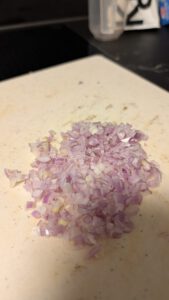
- 1 shallot finely chopped. The photo shows a larger heap of chopped shallots, so use more if you like
- 1 garlic clove finely chopped
- fresh thyme for the duxelles. The original recipe gives no amount
- white wine or dry sherry optional, a splash to deglaze the mushrooms. The original recipe gives no amount; check the label for gluten; not counted in the nutrition estimate
- 6 to 8 prosciutto slices Parma ham, about 100 g (3.5 oz) in total is assumed for the nutrition estimate. It acts as a moisture barrier. Check the label for gluten
- 2 packs Schär gluten-free puff pastry if unsure, take two packs: how much you need depends on the weight and shape of the fillet. Follow the package directions for thawing. The nutrition estimate assumes 275 g (about 9.7 oz) of pastry actually used
- 2 egg yolks for brushing, once on the pastry edges and once all over the outside
- 600 g carrots about 6 to 7 medium, 1.3 lb. Peeled and cut into sticks about 4 to 5 cm (1.5 to 2 in) long
- 1 tbsp good olive oil or butter 15 ml. Olive oil is the better choice
- 3 sprigs fresh rosemary fresh is ideal
- 60 ml water ¼ cup
- 1 to 2 tbsp honey or maple syrup 15 to 30 ml, to glaze
- 1 pinch salt
- Knorr Soße zu Braten (roast gravy mix) to serve as needed; check the label
Instructions
- Season the beef fillet generously all over with salt and pepper.
- Heat oil in a pan until it is extremely hot. Sear the fillet on all sides, including the two ends, only briefly and very hard: about 1 minute per side according to the original recipe. (General guidance, not from the original recipe: a cylinder has more than four sides, so work your way around it.)
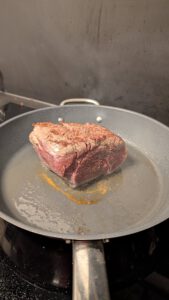
- The fillet should be browned all around but still raw inside. Take it out of the pan right away.
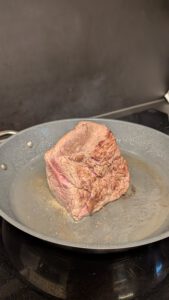
- While it is still hot, brush the fillet all over with a thin layer of the medium hot mustard. Check the label first: the mustard must contain no wheat flour or other gluten-containing ingredients.
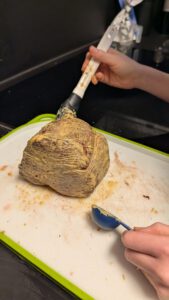
- Now comes the first golden rule: let the fillet cool completely. The original recipe gives no time. (General guidance: it should feel cold to the touch before it goes near the pastry, otherwise the butter in the pastry melts.)
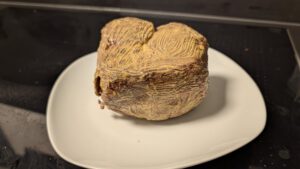
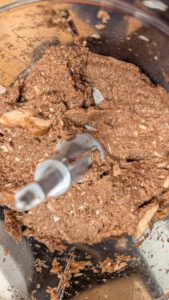
- Make the duxelles. Chop the mushrooms extremely fine, ideally in a food processor, until they look like soil or fine crumbs.
- Finely chop the shallot and the garlic clove.
- Cook the mushroom crumbs with the shallot and garlic in a pan, using no oil or only very little. At first the mixture is wet (see the photo).
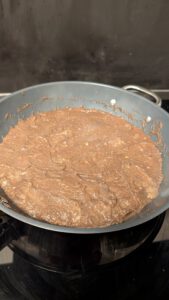
- Add the thyme and keep cooking until the liquid has evaporated. If you like, deglaze with a splash of white wine or sherry (optional, no amount in the original recipe). Second golden rule: cook the mixture until it is almost completely dry. The original recipe adds that if you think it is dry enough, you should cook it 2 minutes longer. Wet mushrooms mean a soggy pastry bottom.
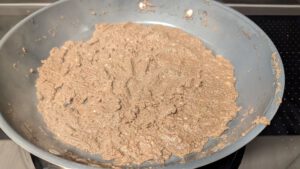
- Let the duxelles cool completely. The original recipe gives no time.
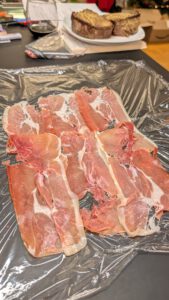
- Spread a large sheet of plastic wrap on the work surface. Lay the prosciutto slices on it, overlapping like roof tiles, to form a rectangle big enough to wrap around the fillet. The prosciutto works as a moisture barrier.
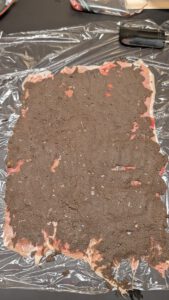
- Spread the cold duxelles evenly over the prosciutto.
- Place the cold fillet in the middle. Using the plastic wrap, roll the prosciutto tightly around the meat. Twist the ends of the wrap like a candy wrapper to pull the roll really tight. (General guidance: a tight roll holds its shape and leaves no air gaps.)
- Chill the roll in the fridge for at least 30 minutes. This firms up the shape.
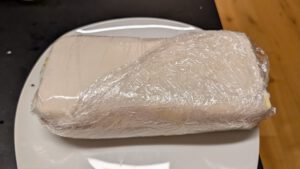
- Roll out the Schär gluten-free puff pastry (follow the package directions for thawing). Take the meat out of the plastic wrap and place it on the pastry. Brush the pastry edges with egg yolk. (If you roll out gluten-free pastry on a surface that has had wheat flour on it, clean the surface and tools first.)
- Fold the pastry around the meat. Cut off excess pastry, because too much overlap on the bottom does not cook through. Press the edges together firmly. Wrap the whole thing tightly in plastic wrap again and chill for another 15 to 30 minutes.
- Preheat the oven to 200 degrees C (390 degrees F) top and bottom heat. The original recipe does not mention a fan oven.
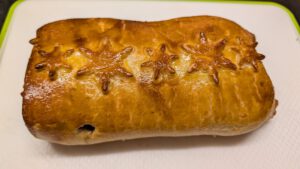
- Unwrap the Wellington and place it on a baking tray. Brush it all over with egg yolk (general guidance: the yolk gives the golden shine). With the back of a knife, gently score a pattern into the pastry, and do not cut through. (The pastry in the photo is also decorated with snowflake cut-outs, which are not part of the original recipe.)
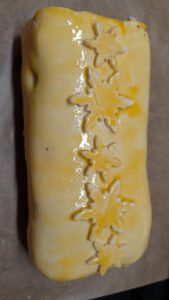
- Ready for the oven. In the photo the tray is lined with baking paper (not mentioned in the original recipe), and offcuts of pastry baked beside the Wellington.
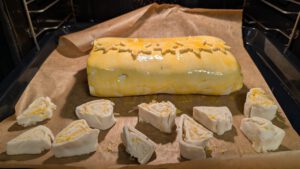
- Bake for about 30 to 35 minutes. The original recipe says a meat thermometer is highly recommended; the photo shows a probe thermometer cable running into the oven.
- About 15 minutes before the Wellington is done, start the carrots. Heat the olive oil or butter in a wide pan over medium heat. Add the carrot sticks and the fresh rosemary sprigs, then a pinch of salt and the water.
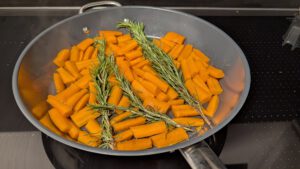
- Cover and cook the carrots over medium heat for about 8 to 10 minutes, until they are nearly tender. Check them with a fork.
- Remove the lid, add the honey or maple syrup and cook for another 2 to 3 minutes, turning the carrots, until the liquid is reduced to a glaze. Remove the rosemary sprigs and keep the carrots warm.
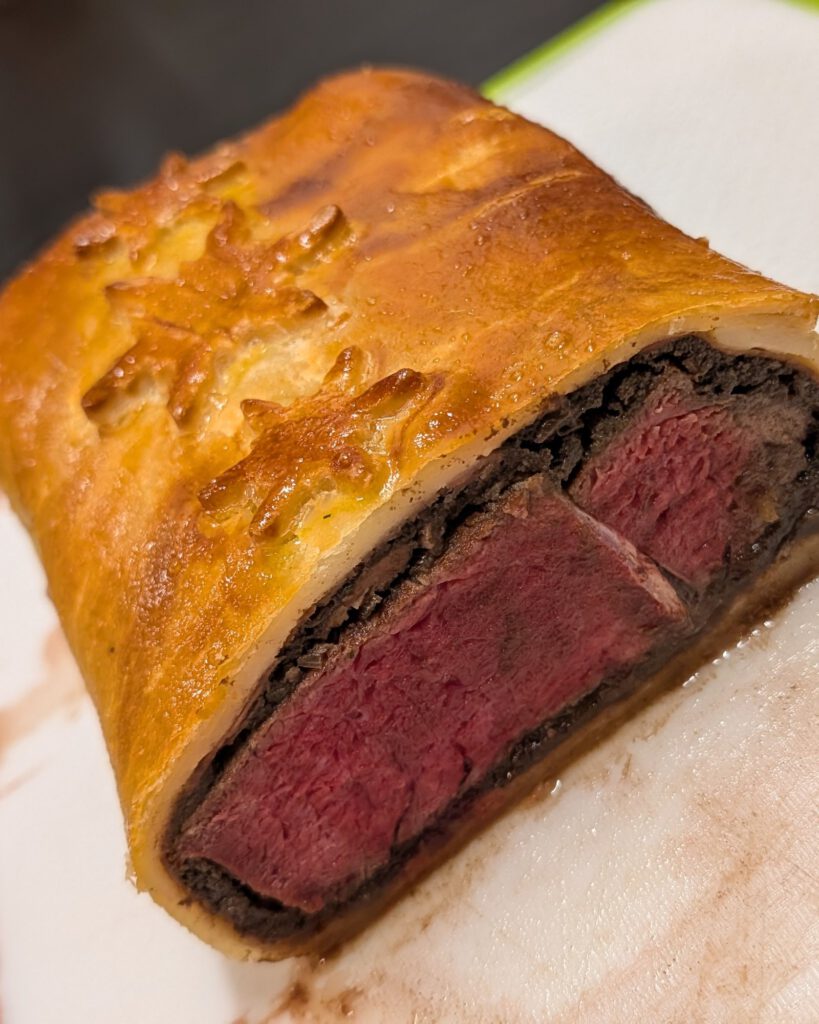
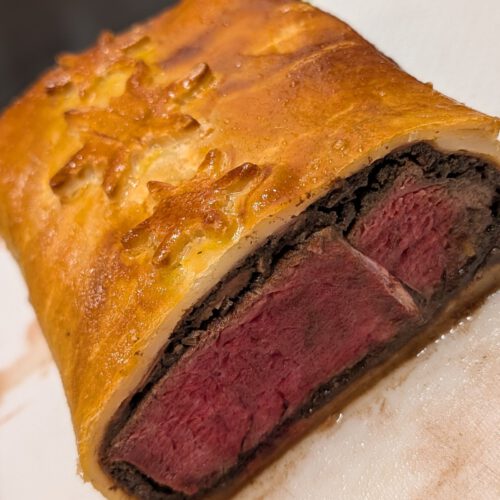
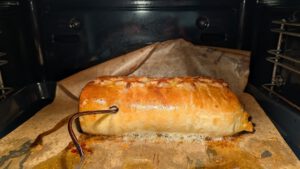
- Take the Wellington out when the core reaches the temperature you like, measured with a thermometer: medium-rare 52 to 57 degrees C (126 to 135 degrees F), medium 60 to 63 degrees C (140 to 145 degrees F). My own preference is the lower end of medium-rare, 52 to 54 degrees C (126 to 129 degrees F). The temperature rises a few degrees while it rests. Safety note: the USDA guideline for whole cuts of beef is 63 degrees C (145 degrees F) with a 3-minute rest, so medium-rare is below that and is not a claim that it is safe. Medium-rare beef is not recommended for pregnant women, small children or people with a weakened immune system; for them cook to the USDA temperature. In the photo the pastry has turned golden.
- Third golden rule: do not slice it right away. Let it rest for at least 10 minutes, otherwise the juices run out and the meat dries. Then slice and serve.
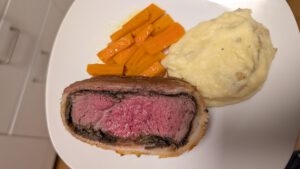
- Serve slices of the Wellington with the Knorr Soße zu Braten (roast gravy mix), the glazed carrots and mashed potatoes (see our recipe for Gluten-Free Mashed Potatoes).
Notes
Questions about gluten-free Beef Wellington
Why must everything be cold before it goes into the pastry?
The original recipe’s first golden rule: never wrap warm meat in puff pastry. The butter in the pastry would melt right away and the pastry would not rise. That is why the seared fillet and the duxelles both cool completely, and why the roll chills for at least 30 minutes and the wrapped Wellington for another 15 to 30 minutes.
How do I avoid a soggy bottom?
Three things from the original recipe work together. Cook the duxelles until it is almost completely dry (if you think it is dry enough, cook it 2 minutes longer), because wet mushrooms mean a soggy pastry bottom. The prosciutto acts as a moisture barrier between the duxelles and the pastry. And cut off excess pastry, because too much overlap on the bottom does not cook through.
Why rest the Wellington for 10 minutes?
The original recipe says to rest it for at least 10 minutes before slicing. If you cut it right away, the juices run out and the meat becomes dry. Resting lets the juices settle in the meat.
Do I need a meat thermometer?
The original recipe highly recommends one. Take the Wellington out at the core temperature you like: medium-rare 52 to 57 degrees C (126 to 135 degrees F) or medium 60 to 63 degrees C (140 to 145 degrees F). My own preference is 52 to 54 degrees C. The USDA guideline for whole cuts of beef is 63 degrees C (145 degrees F) with a 3-minute rest, so medium-rare is not a claim that it is safe, and it is not recommended for pregnant women, small children or people with a weakened immune system. A thermometer is the only reliable way to know the core temperature, because the baking time of 30 to 35 minutes depends on the size of your roll.
What makes this Beef Wellington gluten-free?
The puff pastry. A normal puff pastry is made from wheat, so this version uses Schär gluten-free puff pastry. Also check the label of the mustard (English mustard often contains wheat flour), the prosciutto, the thyme and the optional wine or sherry. If you roll out gluten-free pastry on a surface used for wheat flour, clean the surface and tools first.
Can I prepare parts ahead?
The original recipe only gives the chilling steps: the roll chills for at least 30 minutes after wrapping, and the pastry-wrapped Wellington chills for another 15 to 30 minutes before baking. It gives no longer make-ahead times, so none are claimed here.