
In short
- The ride: 102.8 km (63.9 miles) and about 2,000 m (6,560 ft) of climbing at the Panorama Gravel (Strammer Max), 5 h 29 min of riding, 8 h 4 min including all stops.
- The fuel: almost entirely liquid, from the Decathlon 1:0.8 Drink. About 550 g of powder in total, roughly 527 g of carbohydrate, or about 96 g per hour of riding and about 65 g per hour including all stops. (1:0.8 means 0.8 parts fructose for every 1 part glucose.)
- The food: on the way only an espresso, a meatball, a little potato salad, a cola mix and a coffee with sugar.
- The stomach: no problems. After a small low I had mild thigh cramps that went away again.
- The catch: my gel flasks were about four times stronger than the pack allows. This is not a recipe to copy.
- Celiac disease: the powder is not labeled gluten-free and the pack warns of traces of gluten. I do not recommend it for celiac disease.
Why I care
At Challenge Roth in 2011 I had cramps on the bike, vomited after the second climb of the Solarer Berg, had diarrhea on the run and stopped at about km 18 (mile 11) of the marathon (my race report). In hindsight I am convinced it was my nutrition (my reading, not a proven finding): as I remember it, I tried to take in as much as possible of a 2:1 sugar mix. I was not eating gluten-free then. Today I know I am gluten intolerant, and my younger son has celiac disease. I assume I have celiac disease too, though without his symptoms and without a confirmed diagnosis. So how my gut feels in hour four is more than a side issue for me.
This is one rider on one day. It is not a training plan and not medical advice.
The day
It was a fantastic day: great weather, great people to ride with and a nice get-together afterwards. This post is about fueling, but above all the ride was a huge amount of fun.
From the start to Obersasbach
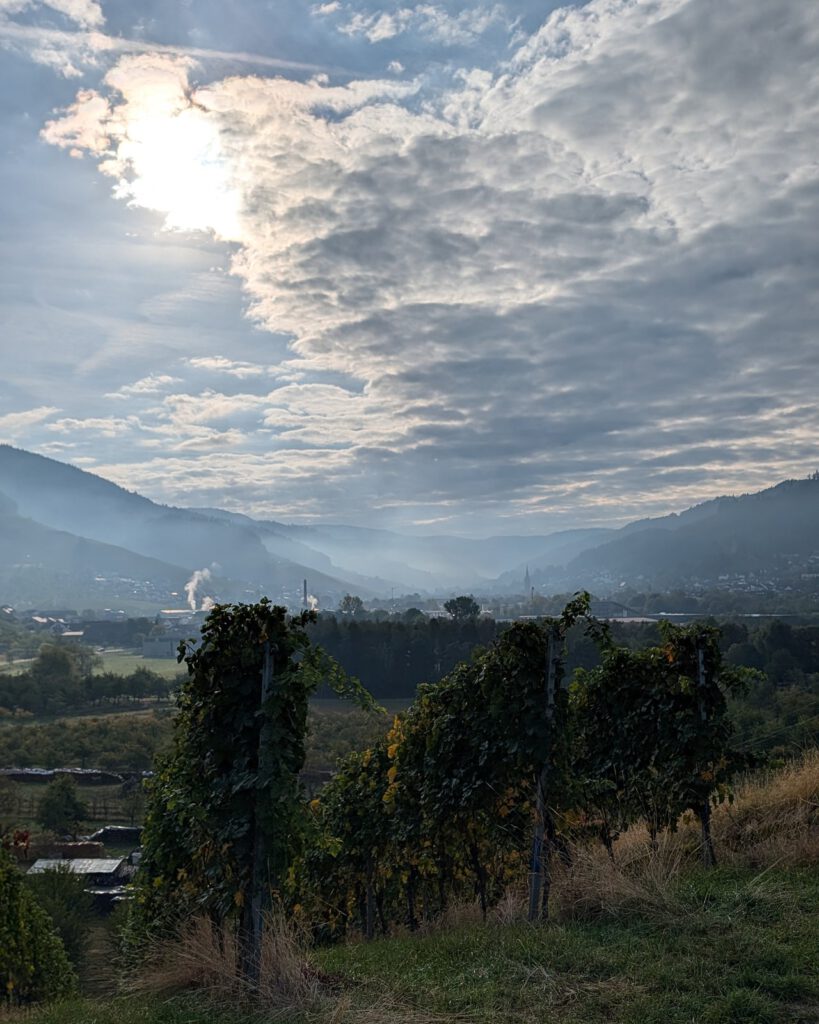
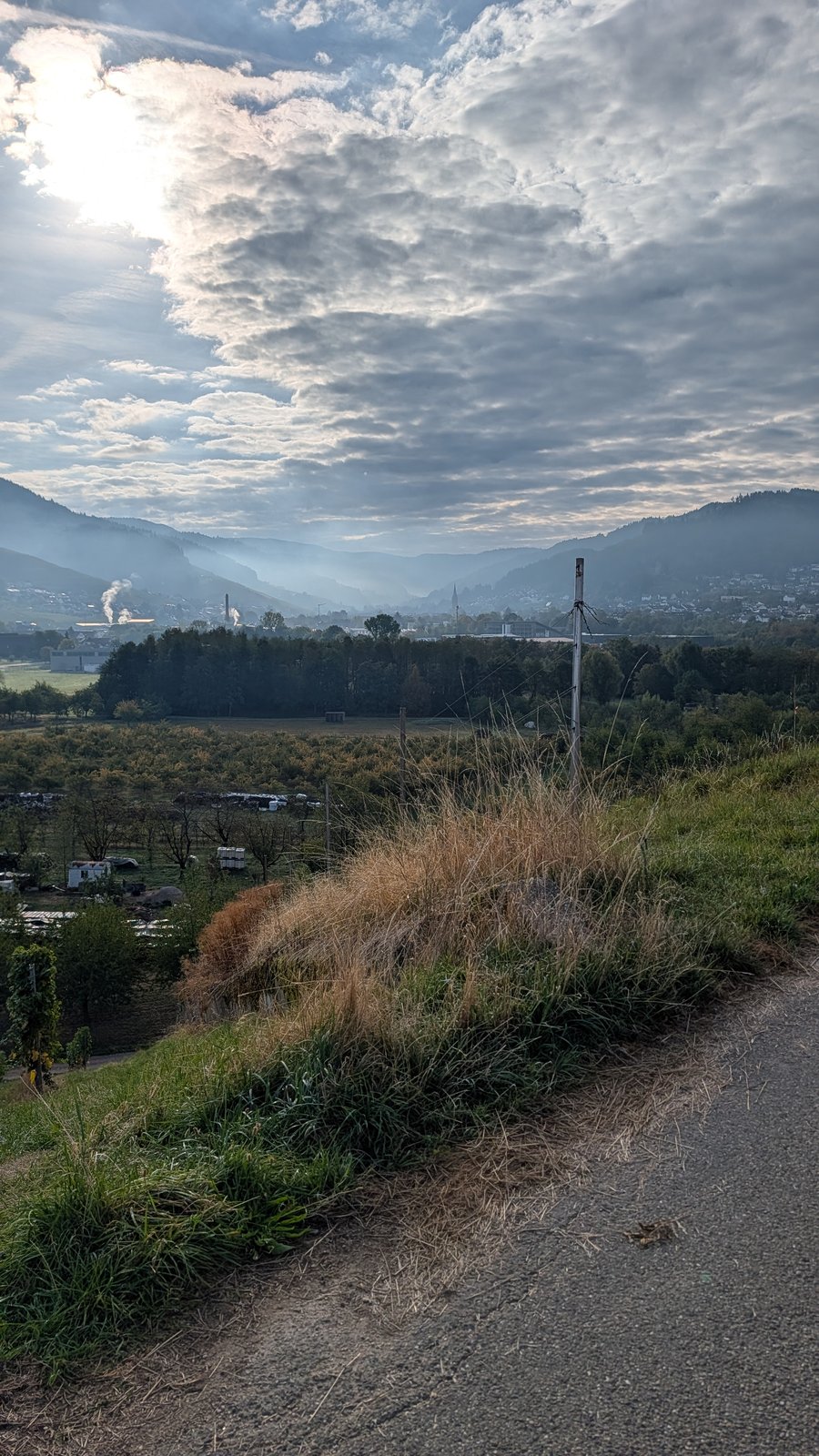
I set off at 07:33 and rode to Bühlertal, where the event starts. The organizer lists the route as 95 km with 1,900 m of climbing; my recording shows 102.8 km because it begins with the ride to Bühlertal (the first 4.6 km). At km 25.6 we stopped at a distillery. The others ate fries with Bibeleskäse (a local herb-and-quark dip); I lived off my bottle and gel flasks. Shortly after, at 09:55, I took the photo of the vineyard in the morning haze while riding. At km 36.2 I had an espresso at a coffee shop by the care home in Obersasbach.
The low before Baden-Baden
Between km 53 and km 67.5 the route climbs about 180 m net and then drops into Baden-Baden, to 171 m at km 73.9. On that descent I had a small low. My heart rate fell to about 115 to 136 bpm. I then drank a lot from a gel flask in one go. Just past the town came a short, steep climb, about 95 m at an average of 151 bpm. Mild cramps started in my thighs, burned on the climb and eased afterwards. That was the only problem of the day.
69 minutes at km 78
At km 78.2 I stopped from 12:49 to 13:58, the longest break of the day. The aid stations at the Panorama Gravel are generous: fries with Bibeleskäse, breaded schnitzel, meatballs. I took:
- about 300 ml of a cola mix
- one meatball
- a little potato salad
- a small coffee with sugar
- water to refill my bottles
That is all: a meatball, a spoonful of potato salad and 69 minutes, not the most efficient fueling in the world, but the most relaxed. We sat together comfortably and waited until everyone had finished their pee breaks. I skipped the schnitzel and fries on purpose. Fatty and protein-rich food is digested slowly, and during hard riding I prefer something that leaves the stomach quickly. The Gatorade Sports Science Institute, an industry-funded source, similarly advises avoiding protein, fat, fiber and milk products to reduce the risk of stomach symptoms during exercise (Prado de Oliveira 2013). I don’t know whether the schnitzel would have hurt me.
The last 25 km
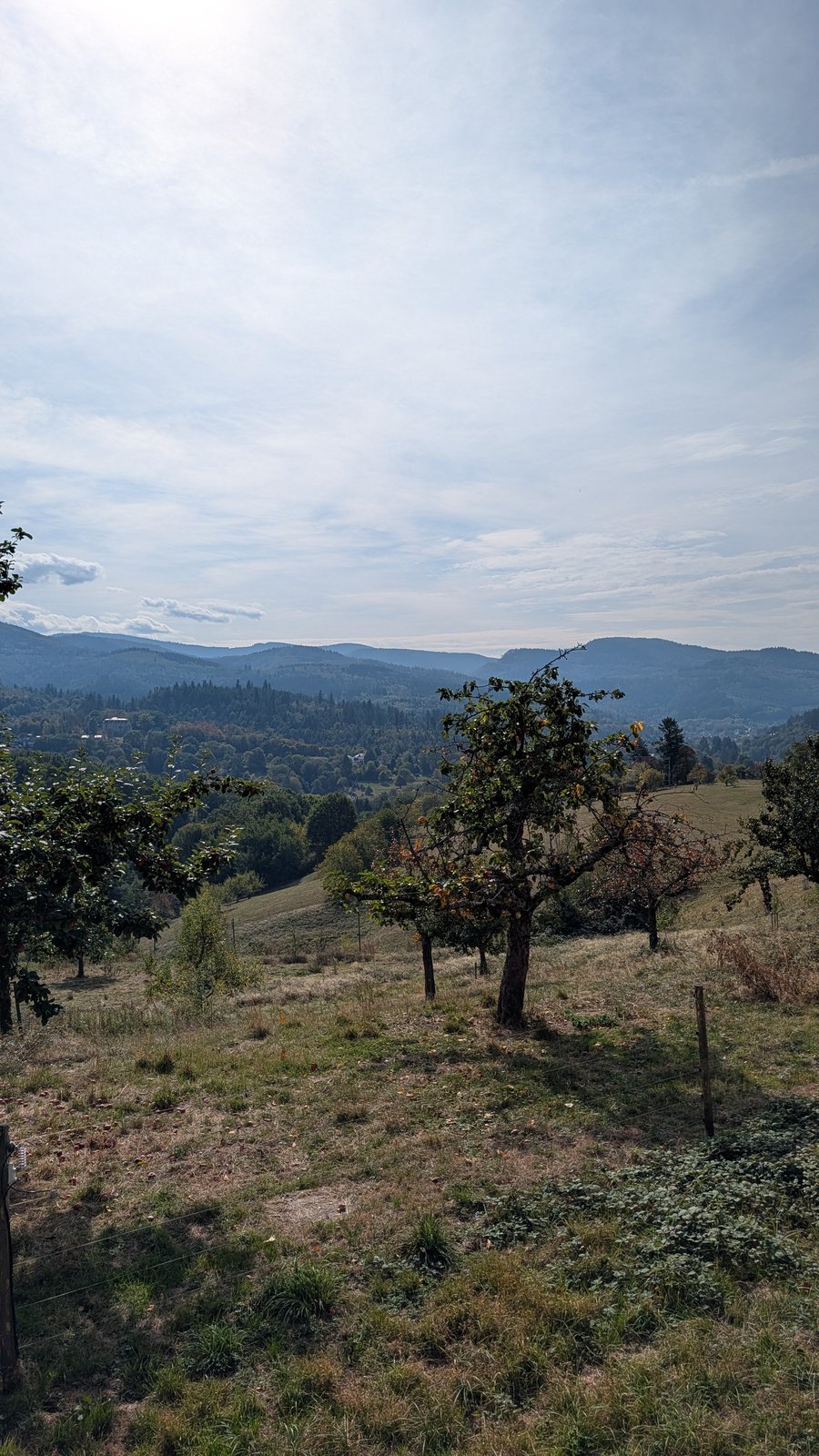
After the stop I rode another 24.6 km with 615 m of climbing, in 1 h 25 min at 17.3 km/h. The highest point of the day is at about km 89, at roughly 570 m. There were no problems. In 2011 my stomach still did the talking; in 2026 it kept quiet. I was happy from start to finish, never doubted myself and never lost the desire to ride. I crossed the finish at 15:37, and afterwards there was a nice get-together.
So I did not ride the whole way without solid food: I ate after about three quarters of the distance. The 69 minutes of rest with a coffee, a cola mix and a small meal may have mattered for the second half as much as the carbohydrate did. I can’t separate the two.
The numbers
| Measure | Value |
|---|---|
| Start / finish | 07:33 / 15:37 |
| Distance | 102.8 km |
| Riding time | 5 h 29 min (18.7 km/h average) |
| Total time with stops | 8 h 4 min |
| Climbing | about 2,000 m (2,000 to 2,200 m depending on how the altitude trace is filtered) |
| Heart rate | 147 bpm average, 169 bpm maximum |
| Energy (the watch’s estimate) | 3,457 kcal |
The energy figure is my Garmin’s estimate, not a measurement of what I burned. I rode the first part (78.2 km) at 19.2 km/h and 146 bpm, the last part (24.6 km) at 17.3 km/h and 148 bpm. The last part was steeper, about 25 m of climbing per km against about 18 before. The terrain alone can explain the slower pace.
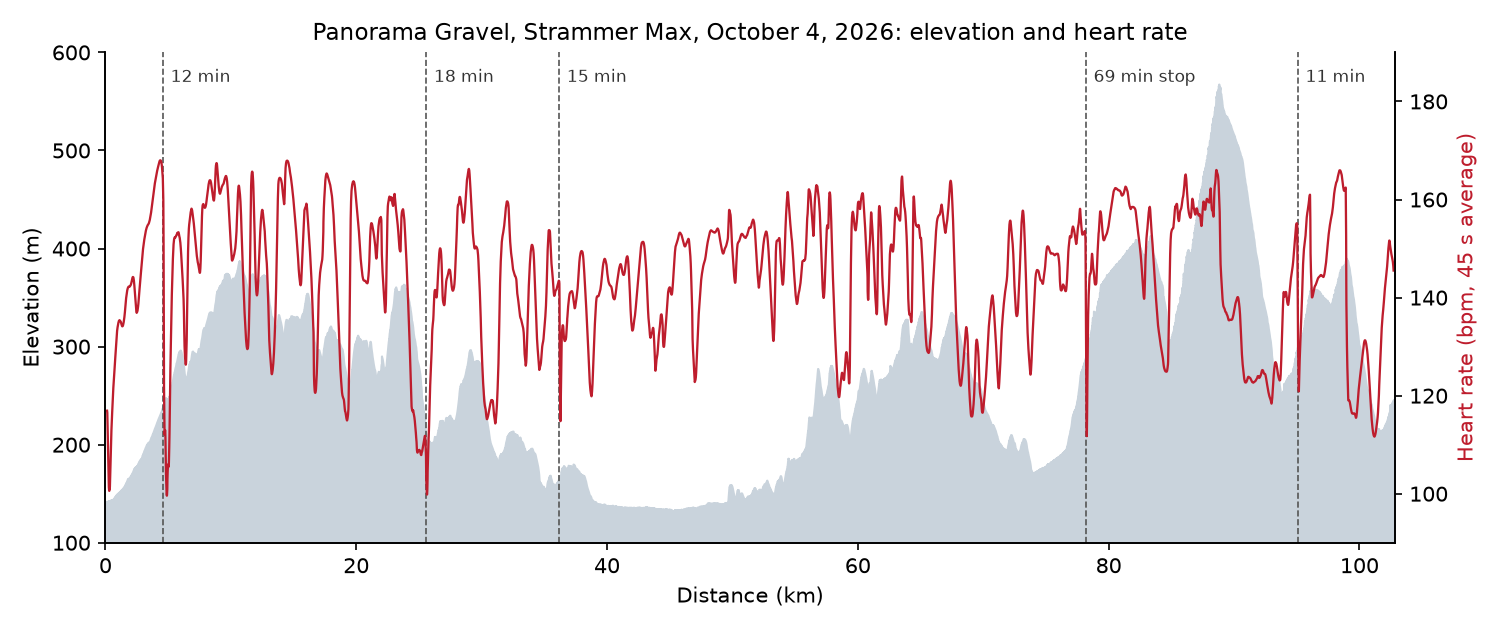
The stops longer than ten minutes: km 4.6 (12 min), km 25.6 distillery (18 min), km 36.2 Obersasbach (15 min), km 78.2 aid station (69 min), km 95.1 (11 min).
What I carried
I used the Decathlon 1:0.8 Drink in the red fruit flavor. Per 100 g of powder the pack states 384 kcal, 96 g carbohydrate (of which 45 g sugars), 1.3 g salt (500 mg sodium), 300 mg potassium and 56 mg magnesium. The label’s recipe is three scoops (100 g) in 500 ml of water. One level scoop weighs about 33 g. I bought the powder myself. There is no sponsorship and there are no affiliate links.
| Container | Powder | Carbohydrate | Strength |
|---|---|---|---|
| 750 ml bottle | 4.5 scoops, about 149 g | about 143 g | 19 g per 100 ml, the strongest mix the label allows |
| Two gel flasks, 225 ml each | 400 g together | about 384 g, roughly 190 g per flask | about 0.85 g per ml, roughly four times the label’s mix |
Everything was empty at the finish. That is about 550 g of powder, 527 g of carbohydrate and 2.75 g of sodium: about 96 g of carbohydrate per hour of riding, or about 65 g per hour over all eight hours including stops. The cola mix and the sugar in the coffee are not included; I don’t know the amounts.
I did not follow the manufacturer’s directions. The pack says: no more than three scoops per 500 ml, drink at least 500 ml of the mix per hour in small portions every 15 minutes, and use the prepared mix within the day. Fitting six scoops into a 225 ml flask was the real gravel stage of the night before. My flasks held about twelve scoops in 450 ml and were mixed the evening before with warm water, because the concentrated powder clumped in cold water. That is what I did, not what I recommend.
What I take from it
- On this one day, about 96 g of carbohydrate per hour, mostly from very concentrated flasks, gave me no stomach trouble. That is one data point, nothing more.
- The only complaint was the mild cramps after the low. I can’t say why, and I found no study showing that carbohydrate or sodium prevents cramps.
- Next time I will mix it once the way the pack says and compare how it feels, keep the stop shorter and note how much I drink from which bottle. The same plan on a second ride would show whether this day was a fluke.
What the research says
During exercise the body oxidizes ingested glucose, or any single carbohydrate, at roughly 60 to 66 g per hour at most, probably because the SGLT1 transporter in the gut wall is saturated (Jeukendrup 2014). Fructose uses a different transporter, GLUT5, so more carbohydrate can reach the muscle (Podlogar & Wallis 2022). The 1:0.8 on the pack is a glucose-to-fructose ratio of that kind.
- Guidelines (ACSM 2016, as summarized by Morton et al.): up to 90 g of carbohydrate per hour for efforts longer than about 2.5 hours. A 2026 review says 120 g/h may be possible for trained athletes but calls a performance benefit not yet substantiated (Morton et al. 2026). Another 2026 review is skeptical of very high intakes (Plews et al. 2026).
- Trials with 1:0.8: 15 trained men rode four hours; power in a 15-minute time trial afterwards fell by 6.4 percent with 100 g/h and by 9.3 percent with 60 g/h (Mazza et al. 2026). In 16 cyclists, critical power after three hours fell less the more carbohydrate they took, up to 120 g/h (Norte et al. 2026). Nine men tolerated 120 g/h as drink, gel or chew with minimal complaints (Hearris et al. 2022).
- Limits: small studies, trained men, lab. None compares 1:0.8 with 2:1, none tested flasks as concentrated as mine, none shows a faster 100 km. Mazza and Norte had no 90 g/h arm. Older work links very concentrated solutions to more stomach problems (Jeukendrup 2017). I had none, and that may not hold for you.
- Gut training: in two of eight small studies complaints fell by 47 percent on average, in one by 26 percent. The studies differ a lot (Martinez et al. 2023).
- Cramps: in a 2026 meta-analysis the strongest risk factor was earlier cramps (about 4.4 times the odds). It found no consistent link with hydration; only higher potassium and magnesium after the race were associated, on limited evidence (Costa et al. 2026).
If you have a medical condition, ask your doctor or dietitian before you copy anything from a blog post, including mine. The study details come from the abstracts, not the full texts.
A note for celiac riders
A 1:0.8 ratio says how much glucose and fructose a product contains, not whether it has gluten. Maltodextrin can be made from wheat, and in the EU wheat-based glucose syrups and maltodextrins do not have to be labeled as an allergen. A food may only be called gluten-free if it contains at most 20 mg/kg of gluten (Regulation (EU) 828/2014).
The pack I used lists maltodextrin, fructose, sodium citrate, citric acid, natural flavoring, potassium chloride and magnesium salts of citric acid. It is not labeled gluten-free and says: “May contain traces of milk, soybeans, egg, fish, gluten and nuts.” I used it knowing about that warning and did not test it for gluten myself. That I had no stomach problems says nothing about whether it is safe for you if you have celiac disease. I cannot guarantee anything. Because the pack warns of traces of gluten, I do not recommend it for celiac disease. A warning such as “may contain traces” is a voluntary precautionary label with no legal limit in the EU. It means neither that the product is gluten-free nor that it is contaminated, and it is not an all-clear. Please decide for yourself, and if you are unsure, ask the manufacturer before you buy it.
Sources
- Morton et al. 2026, From Metabolism to Medals, J Nutr
- Plews et al. 2026, Fuelled or Fooled?, Sports Med
- Mazza et al. 2026, 100 vs 60 g/h during 4 h of cycling, Med Sci Sports Exerc
- Norte et al. 2026, graded carbohydrate up to 120 g/h, Scand J Med Sci Sports
- Hearris et al. 2022, 120 g/h as drink, gel or chew, J Appl Physiol
- Martinez et al. 2023, gut training, systematic review, Sports Med
- Costa et al. 2026, risk factors for muscle cramps, meta-analysis, Muscle Nerve
- Jeukendrup 2014, carbohydrate intake during exercise, Sports Med
- Jeukendrup 2017, training the gut for athletes, Sports Med
- Podlogar & Wallis 2022, carbohydrate research for endurance athletes, Sports Med
- Prado de Oliveira 2013, GSSI Sports Science Exchange 114
- Regulation (EU) 828/2014 on gluten-free labeling
- Garmin activity file of October 4, 2026; label of the Decathlon 1:0.8 Drink (red fruit)